The K-bus on the ibaW-750 device is asynchronous, i. e. independent of the ibaNet-E sampling rate or the time base set in the ibaPDA.
The K-bus cycle time depends on the number and the type of the connected terminals and may vary. Digital modules have less influence on the K-bus, analog modules have more and the complex and parameterizable modules have the greatest influence.
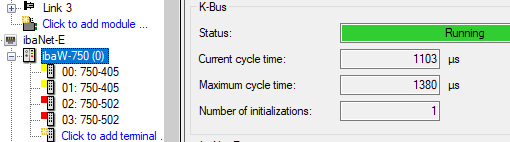
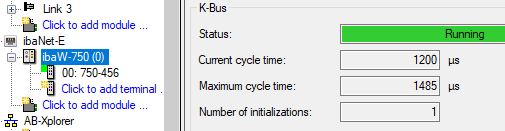
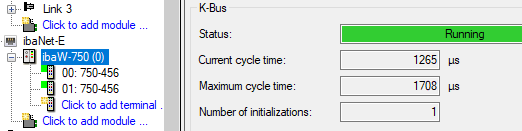
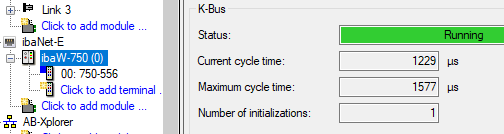
The current cycle time on the K-bus is measured with each cycle and is displayed on the Diagnostics tab in the Current cycle time field.
With the ibaW-750 device, however, it should be noted that the K-bus cycle time can only be a minimum of 1 ms (1000 µs) due to the system.
Unfortunately, the cycle time cannot be calculated in advance in ibaW-750.
The actual K-bus cycle time can be seen in ibaPDA only after initial operation.
Here are some examples with measured cycle times:
Digital terminals
-
1 x 2-channel digital input terminal WAGO750-405
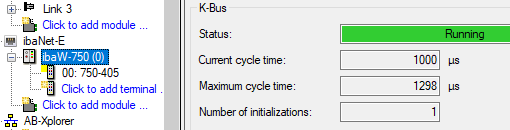

-
2 x 2-channel digital input terminal WAGO750-405
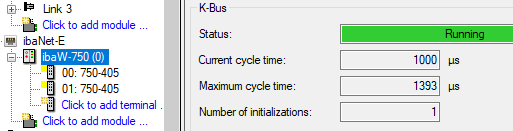

-
1 x 2-channel digital output terminal WAGO750-502
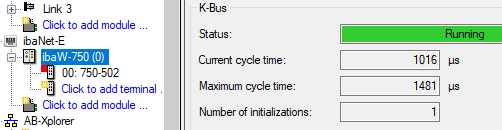

-
2 x 2-channel digital output terminal WAGO750-502
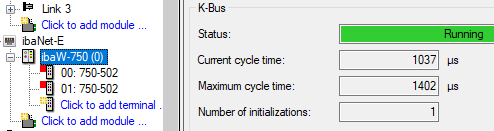

-
2 x 2-channel digital input terminal WAGO750-405 and 2 x 2-channel digital output terminal WAGO750-502

Analog terminals
-
1 x 2-channel analog input terminal WAGO750-456

-
2 x 2-channel analog input terminal WAGO750-456

-
1 x 2-channel analog output terminal WAGO750-556

-
2 x 2-channel analog output terminal WAGO750-556
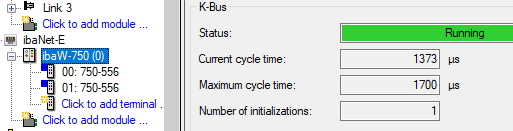

-
2 x 2-channel analog input terminal WAGO750-456 and 2 x 2-channel analog output terminal WAGO750-556
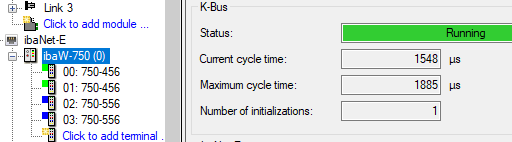

Digital and analog terminals

Complex and configurable terminals
-
1 SSI encoder interface WAGO750-630
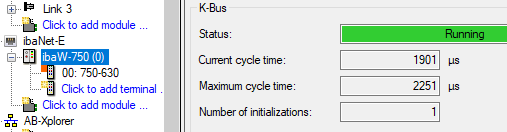

-
1 x 3-phase power measurement terminal WAGO750-494
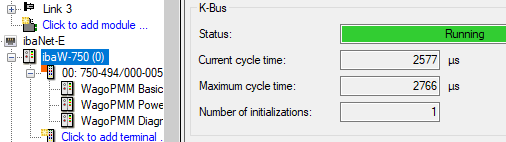

-
2 x 3-phase power measurement terminal WAGO750-494
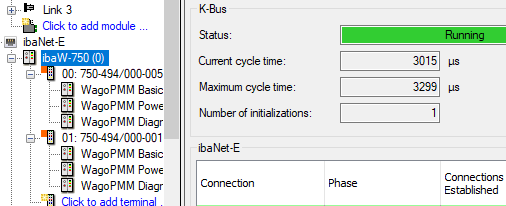

Digital, analog, complex and configurable terminals combined
When operating with mixed bus terminals (digital, analog, complex and configurable), the K-bus cycle time increases to over 5 ms with only 16 bus terminals connected.
