In ibaQDR v7 a new file format has been introduced and there have also been some changes to the structure of the signals in the ibaQDR data files.
Signal ID
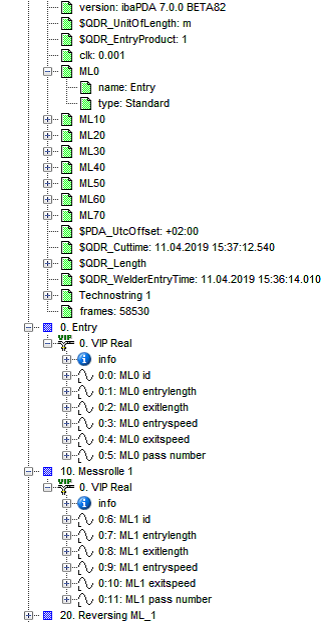
The most important change is that the measuring location number is no longer part of the signal ID. In ibaQDR v6 files a signal with the ID [0:0], belonging to the first measuring location (no. 0), was saved in the product file with the signal ID [0.0:0]. A signal with the ID [0:6], belonging to the second measuring location (no. 10), was saved in the product file with the signal ID [10.0:6].
From ibaQDR v7 the signals are only saved with their original ID. Thus, a signal with the ID [0:0] will always have the ID [0:0] regardless of which measuring location it belongs to. The advantage is that there are no longer any additional restrictions for the signal IDs in ibaQDR files. The following figures show a data file from ibaQDR v6 on the left and a data file from ibaQDR v7 on the right.
 |
|
Saving time and length-based data
A further change is the way in which the time and length-based data for a signal is saved in the data file. In ibaQDR v6 the length and time data was saved in two separate signals.
The length signal had the measuring location number times 10 as the first number in the ID.
The time signal had the measuring location number times 10 plus 1 as the first number in the ID.
In ibaAnalyzer the length and time signal can be represented together, as in the previous figure, or they can be represented separately, as in the figure below. For example, for the signal [0:6] the length data was saved as the signal [10.0:6] and the time data as the signal [11.0:6].

From ibaQDR v7 the time and length data in a signal is saved as a single signal. The signal includes both time and length data. In ibaAnalyzer it behaves in exactly the same way as the ibaQDR v6 file with combined time and length signals. ibaAnalyzer has a compatibility function that allows the ibaQDR signals to be addressed using their old ibaQDR v6 ID. This function is useful when you are updating an ibaQDR v6 system to the latest version and want to continue using your old analyses (pdo files).
In ibaAnalyzer, you can address the signal [0:6] from the mapping as [0:6], [10.0:6], and [11.0:6]. This means that you can use the signal, e.g. in an expression, in all three familiar forms, with [11.0:6] supplying the time-based signal and [10.0:6] the length-based signal.