The following describes the configuration of the Request blocks in STEP 7.
For each Request module
-
Copy the following blocks from the iba S7 library to the blocks folder of your STEP 7 project, see iba S7 library.
-
ibaREQ_M (FB1400), see ibaREQ_M (FB1400)
-
ibaREQ_UDP2 (FB1406), see ibaREQ_UDP2 (FB1406)
-
ibaREQ_UDPact (FB1410), see ibaREQ_UDPact (FB1410)
-
ibaREQ_DB (DB15)
-
ibaREQ_DB-Interface (PLC data type)
Note

Only use Request blocks from the latest iba S7 library!
Request blocks in application examples can be outdated and, thus, cause errors.
Note
The request blocks do not support multi-instance calls.
-
-
Call the ibaREQ_M (FB1400) preferably within the OB1.
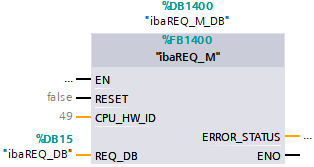
-
Enable the Retain option for the entire instance block that you have just created.
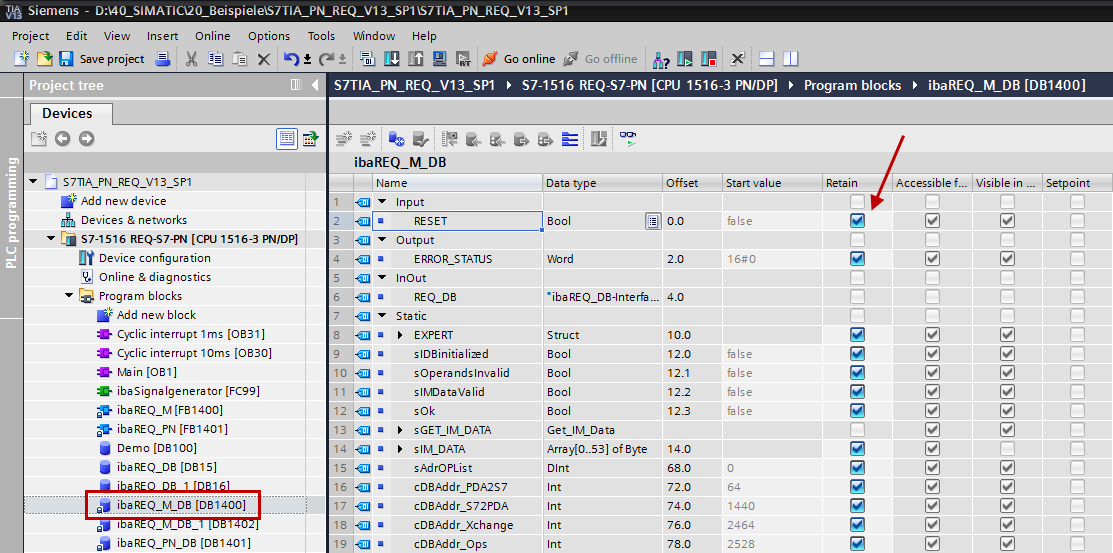
-
Call the ibaREQ_UDP2 (FB1406) preferably within a cyclic interrupt OB (OB3x).
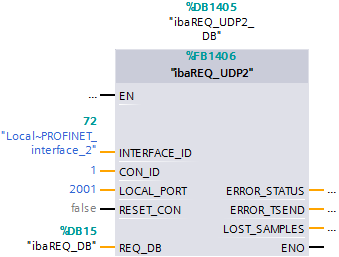
For each additional Request module
-
In the blocks folder, a data block ibaREQ_DB (DB15) has to be available for each Request module. Copy the data block and assign a new unique DB number.
-
Within the OB1, the ibaREQ_M (FB1400) has to be called once more with the new DB number for each Request module.
-
Within the cyclic interrupt OB (OB3x), the ibaREQ_UDP2 (FB1406) has to be called once more with the new DB numbers for each Request module.
-
Make sure that all instance data blocks are unique and that unique values are assigned for the CON_ID and LOCAL_PORT.
Final
-
Load all blocks into the S7 CPU and restart the S7 CPU.