ibaPDA-Interface-Generic-UDP can be used by any controller capable of sending UDP/IP messages.
The User Datagram Protocol (UDP) is one of the core protocols of the Internet protocol suite. Using UDP, programs on networked computers can send messages to one another. These messages are also called datagrams.
As the sender does not get any confirmation that the data have been received, UDP is in contrast to TCP not connection oriented and not reliable. However, one advantage resulting from this are the higher data rates that can be transferred with UDP.
The Generic-UDP messages are IP Unicast messages that one or several controllers send to the ibaPDA system using a specified port number.
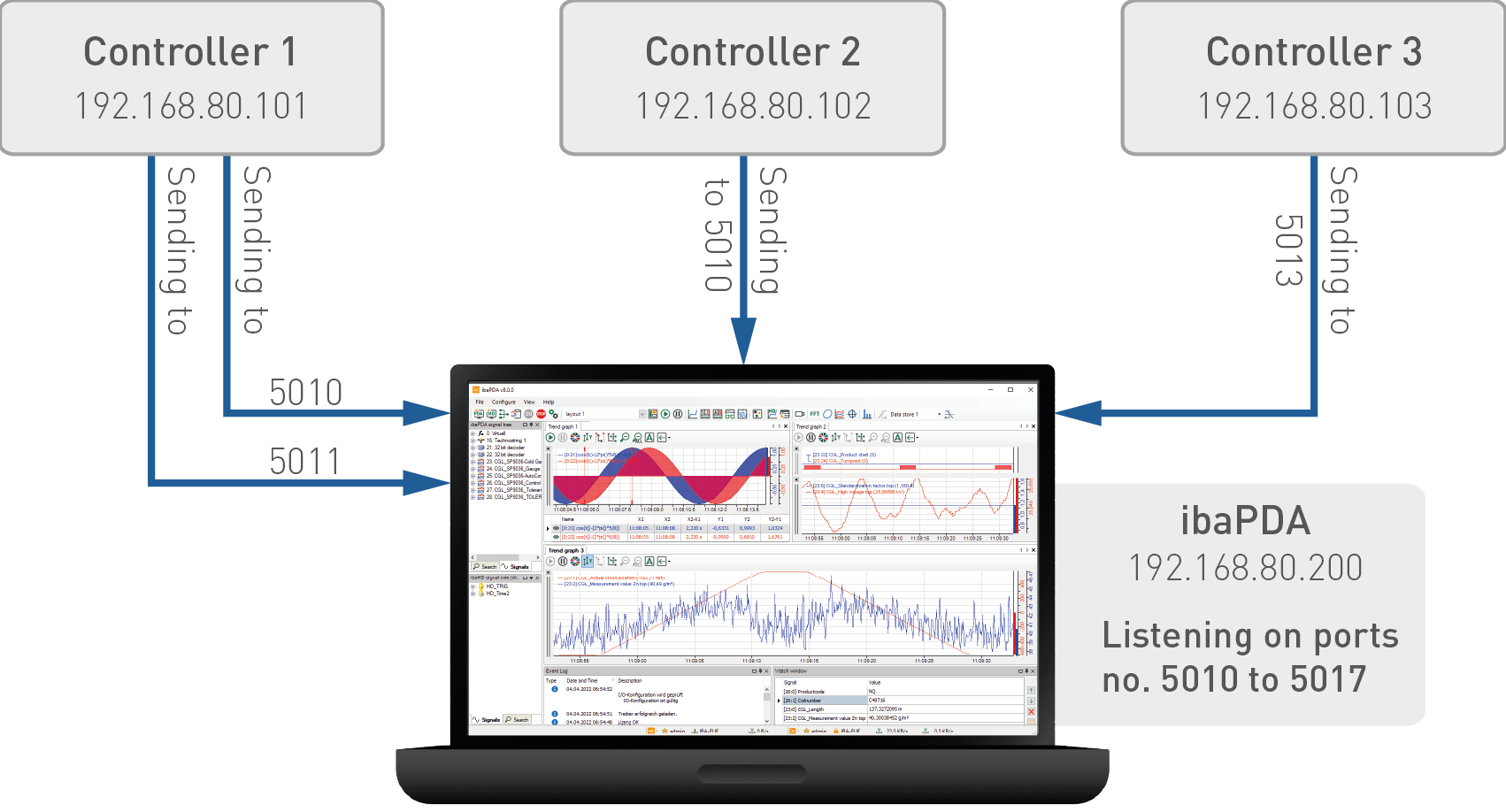
The following drawing gives an overview of a possible configuration scenario where three controllers are sending UDP messages to one ibaPDA system.
Properties
-
The messages sent over each connection can have any data structure.
-
You can define a port range on the Generic-UDP interface in the ibaPDA I/O Manager. In the above example, the ibaPDA driver is listening on port 5010 to port 5017 for incoming UDP messages.
-
Each UDP connection is uniquely identified within ibaPDA by the destination port number and the source IP address.
Thus, ibaPDA can receive data from different controllers, which use the same destination port. It is also possible to send messages from one controller to ibaPDA over different ports.
This is shown clearly in the above example: Controllers 1 and 2 use the same port 5010 but have different IP addresses. Controller 1 sends several messages and uses different ports for sending (5010 and 5011).
ibaPDA specific limitations
-
The maximum length of the UDP message is limited to 4096 bytes.
-
The number of the supported connections in ibaPDA depends on the Generic-UDP license (64, 128, 192 or 256).
The following controllers apply:
-
Any system capable of sending UDP/IP messages
Other documentation |
|
|---|---|
 |
Reference to additional documentation or further literature.
|