The data acquisition cycle depends on the following parameters:
Timebase of the ibaBM-DDCS interface in ibaPDA:
Can be set in the ibaPDA I/O Manager under “ibaBM-DDCS - General - Time base”. Default value: ibaPDA acquisition timebase (I/O Manager – General).
The fastest time that can be set, depends on the number of values that is transferred via the FO connection, including all devices that are connected to the same link via cascade.
The data size is limited to 4060 Byte, the fastest timebase is 0.025 ms. ibaPDA gives a warning note, if the data size is too large or the timebase is too fast. Under “FOB-xx-D - Link x – Info” (connection status), you can see the current number of bytes that are transferred.
Access via Data Set:
The data cycle depends on the limitation on the FO side, which is described above.
Access via Parameter:
As every variable is requested via handshake (request – response), the data cycle depends on the number of values (approx. 2 ms per analog value and per 16 digital bits), i.e. the fastest data cycle for 100 analog values is approx. 200 ms.
Tip |
|
|---|---|
 |
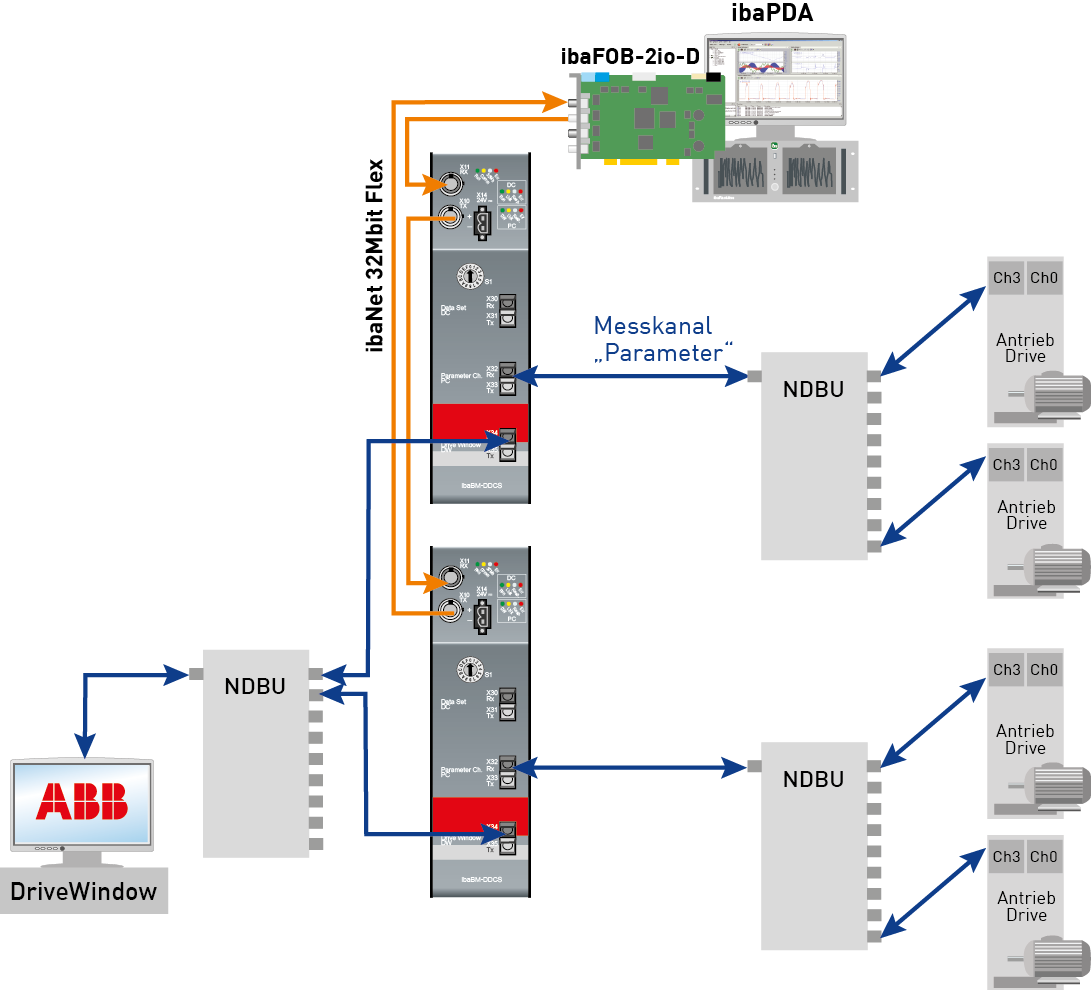
Request times become very high when many drives are connected. In order to improve this behavior, iba recommends using several ibaBM-DDCS devices.
|
In ibaPDA you can assign the setting “Fast” to the parameter values. The sequence of the requested parameter values can be influenced by this setting. Values which are set to ”Fast” are sent in each cycle. Additionally, only one slow parameter value (“Fast” not activated) will be sent with each cycle.
Example:
8 analog parameter values are captured in total: 2 values which are set to “Fast” and 6 slow values. The 2 fast values and 1 slow value are sent with each cycle, in total 3 values. Hence, one cycle takes 6 ms.
Each slow value is captured in every 6th cycle, that means every 36 ms.

|
Legend: |
 |
1st and 2nd parameter value „Fast“ |
|
1st to 6th parameter value „Slow“ |